Guide
Software engineering interview guide
Dec 7, 2025
This is a curated, structured guide you can follow to prepare for software engineer interviews at FAANG and similar companies. It covers:
- Coding and data structures
- System design
- AI and ML foundations (for senior or ML-leaning roles)
- Real mock interviews on YouTube so you can see what good looks like
1. Big picture: how to use this guide
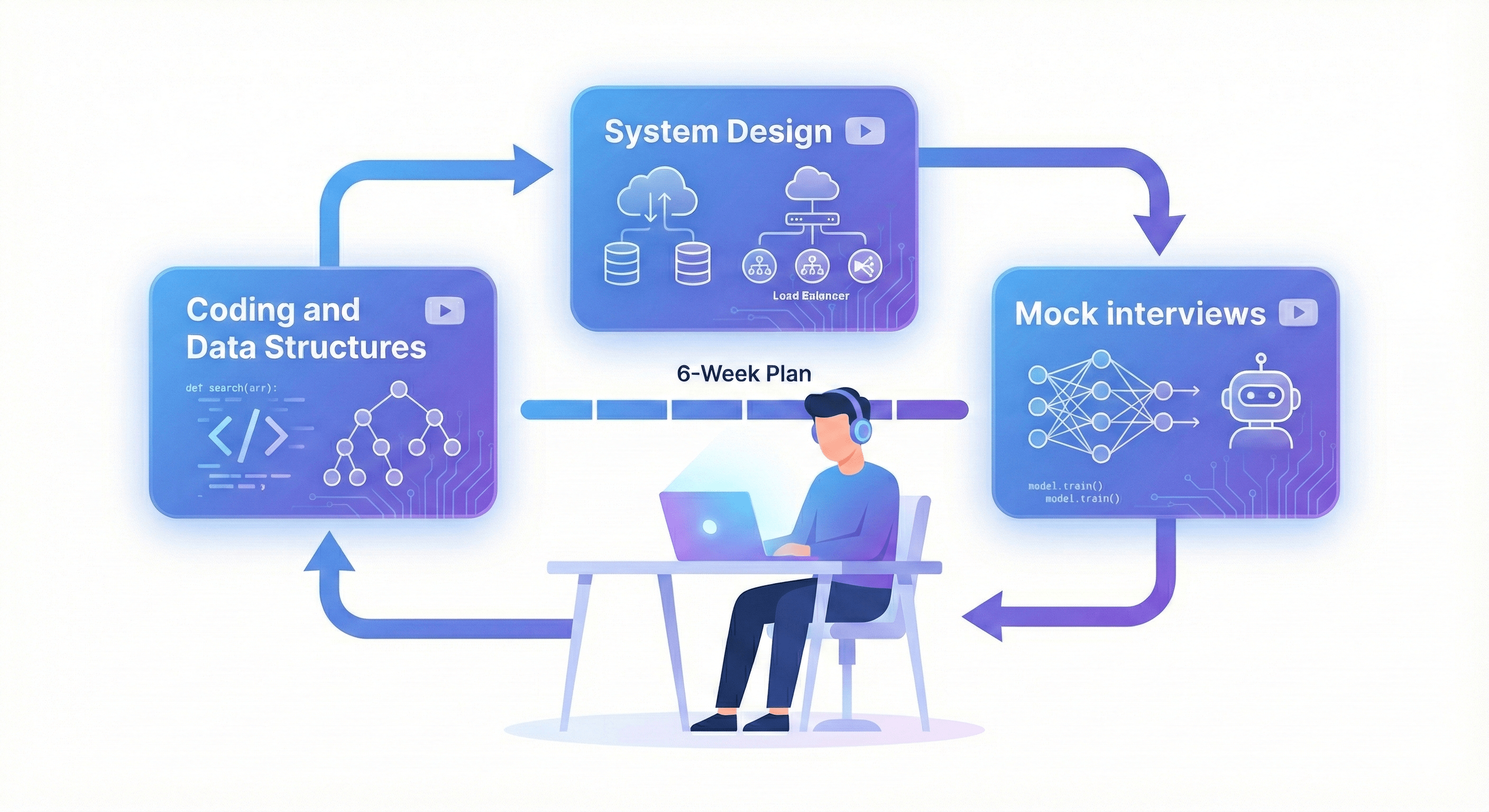
Think of your prep in three parallel tracks:
-
Coding and data structures
Target: consistent performance on LeetCode medium questions in 30 to 40 minutes. -
System design
Target: clear, structured answers for classic design problems in 30 to 45 minutes. -
Deep dive and extras
Target: stronger fundamentals and optional AI or ML knowledge for senior or specialist roles.
A rough split each week while actively preparing:
- 60 percent of your time on coding and data structures
- 25 percent of your time on system design
- 15 percent of your time on reading, AI or ML resources, and mock interviews
2. Language and OOP foundations (Python)
If your main interview language is Python, start by making sure your object oriented programming skills are solid. These are especially useful when an interviewer asks you to design classes or build a small system in code.
2.1 Python OOP theory
For OOP with Python, these two resources are a strong combination of theory and hands on practice:
-
Microsoft Learn module: Object oriented programming in Python
Object oriented programming in Python -
Real Python tutorial: Python 3 Object Oriented Programming
Python 3 Object Oriented Programming
2.2 Python OOP full courses on YouTube
You can pair the articles above with one of these free video courses:
-
Object Oriented Programming with Python - Full Course for Beginners (JimShapedCoding)
Object Oriented Programming with Python - Full Course for Beginners -
Python Object Oriented Programming (OOP) - For Beginners (Tech With Tim)
Python Object Oriented Programming (OOP) - For Beginners
Pick one and finish it end to end. While watching:
- Pause and code along
- Rewrite the main examples from memory the next day
- Try to model a small real world problem, such as a library, todo list, or music playlist
3. Coding interview prep (DSA and LeetCode)
3.1 Core platforms
Use a combination of problem solving and structured lessons:
-
LeetCode for problems and contest-style practice
LeetCode -
Exponent Software Engineering Interview Prep Course for structured lessons and walkthroughs
Exponent Software Engineering Interview Prep Course
A simple pattern that works well:
- Watch one Exponent lesson
- Do one or two related LeetCode questions
- Write down patterns and mistakes
3.2 Recommended LeetCode study plans
These are handpicked lists that cover most of the patterns you need for FAANG style interviews:
-
LeetCode 75 Study Plan (great starting point)
LeetCode 75 Study Plan -
Blind 75 list on LeetCode Discuss (classic curated set)
Blind 75 on LeetCode Discuss -
Top Interview 150 Study Plan (more breadth, closer to real interview coverage)
Top Interview 150 Study Plan
You do not need to finish every single problem to be ready, but you should be comfortable with all the patterns these lists cover.
3.3 Video courses for data structures and algorithms
If you prefer learning from video along with LeetCode:
-
Data Structures and Algorithms Full Course (Java)
Search for the exact title:Data Structures and Algorithms Full Course 📈【Free】.
Use this as background plus pattern recognition while you code in your own language. -
Algorithms and Data Structures Tutorial - Full Course for Beginners (freeCodeCamp, Python)
Algorithms and Data Structures Tutorial - Full Course for Beginners
Recommendation:
- Do one or two chapters from a video course per week
- Immediately reinforce each new topic (for example, trees or graphs) with 3 to 5 LeetCode problems on the same theme
3.4 GitHub repositories for DSA
These repositories can help you review solutions, patterns, and topic wise question sets:
-
Awesome DSA Resource
Awesome DSA Resource -
DSA Resources by GDSC KIIT
DSA Resources by GDSC KIIT -
Awesome LeetCode Resources
Awesome LeetCode Resources -
GitHub topic page for DSA, where you can discover more curated lists
GitHub topic: dsa
Use these as reference, not as a replacement for solving problems yourself. Look up a solution only after you have genuinely tried a problem for at least 20 to 30 minutes.
3.5 How to practice coding effectively
A simple daily loop that works well:
- Warm up with 1 easy or previously solved problem
- Solve 1 new medium problem from your current list (LeetCode 75, Blind 75, or Top 150)
- Reflect and revise:
- Write the solution on paper or in a separate file without looking
- Summarize the key idea in one or two sentences
- Once or twice per week, simulate a real interview:
- 45 minutes
- Talk aloud
- Use a timer
- Write code in a plain editor or whiteboard, not in the LeetCode IDE
4. AI and ML resources (optional but valuable)
If you are aiming for ML engineer roles, or you just want extra context about modern AI systems that may come up in senior interviews, these curated lists are a good starting point:
-
Awesome AI and ML resources
Awesome AI and ML resources -
Awesome Generative AI Guide
Awesome Generative AI Guide
Treat these as long term reading. You do not need to finish them before your standard software engineer interviews, but they can give you strong talking points for ML, infra, or AI related roles.
5. System design interview prep
System design starts to matter a lot for mid level and senior roles, and some companies will ask at least one design question even at entry level.
5.1 First learn the core concepts
A great starting point is this YouTube walkthrough:
- System Design Interview - Step By Step Guide
System Design Interview - Step By Step Guide
Watch and take notes on:
- How they clarify requirements
- How they estimate scale
- How they break the system into components
- How they talk about tradeoffs
5.2 Courses
After the initial intuition, these courses give you structured practice:
-
Grokking the System Design Interview (Educative)
Grokking the System Design Interview -
Exponent System Design Interview Course
Exponent System Design Interview Course -
Exponent System Design Practice Questions
Exponent System Design Practice Questions
Focus on a small set of high yield systems first, such as:
- URL shortener
- News feed
- Messaging or chat
- File storage or photo sharing
5.3 Books and deep dive reading
For deeper understanding and long term growth, these are worth studying over months:
- System Design Interview: An Insider's Guide (Alex Xu)
This is one of the best single books for interview style design.
You also have a set of PDFs and notes collected in your own Google Drive folder:
- Personal system design and coding book folder
Personal system design and coding book folder
Use these books for weekend deep dives and to fill in gaps after you have done the basic courses.
6. YouTube sample coding interviews
Watching real mock interviews is one of the fastest ways to calibrate your expectations for FAANG style interviews. Try to actively pause, solve, and compare your approach.
Recommended coding mock interviews:
-
Software Engineering Job Interview - Full Mock Interview (freeCodeCamp)
Software Engineering Job Interview - Full Mock Interview -
GOOGLE Coding Interview | Mock Google Onsite Interview (Fraz)
GOOGLE Coding Interview | Mock Google Onsite Interview -
Google Coding Interview With A High School Student (Clément Mihailescu and William Lin)
Google Coding Interview With A High School Student
How to use these videos:
- Watch the first 5 minutes to understand the question
- Pause the video and try to solve it yourself
- Resume, compare your approach, and note what you can copy:
- How they communicate
- How they structure their solution
- How they handle hints and corrections
7. YouTube sample system design interviews
After you have basic system design concepts, practice by watching and mimicking real mock interviews.
7.1 General system design walkthrough
- System Design Interview - Step By Step Guide
System Design Interview - Step By Step Guide
7.2 Mock system design interviews for classic products
Try these three in order:
-
System Design Mock Interview: Design Instagram
System Design Mock Interview: Design Instagram -
System Design Mock Interview: Design TikTok (with Google TPM)
System Design Mock Interview: Design TikTok -
Amazon System Design Interview: Design Parking Garage (Exponent)
Amazon System Design Interview: Design Parking Garage
For each video:
- Before you start, read the title and sketch your own high level design in 10 minutes
- Then watch and refine your notes
- Track patterns: feed systems, queues, caches, databases, and how they talk about failure cases
8. Putting it together: a sample 6 week plan
This is just an example. Adjust based on your schedule.
Weeks 1 to 2
- Finish one Python OOP course from section 2
- Start LeetCode 75 and solve 2 problems per day
- Watch 2 to 3 chapters of the Algorithms and Data Structures video course
- Watch System Design Interview - Step By Step Guide once and take notes
Weeks 3 to 4
- Shift to Blind 75 or Top Interview 150. Aim for 2 to 3 problems per day
- Start Grokking the System Design Interview or the Exponent system design course
- Watch one coding mock interview and one system design mock interview each week
- Do one 45 minute self mock coding interview every weekend
Weeks 5 to 6
- Focus on your weak topics from LeetCode stats and notes
- Repeat key system design examples: news feed, messaging, file storage, and one from section 7.2
- Skim chapters from System Design Interview: An Insider's Guide and your PDF folder
- Schedule at least two live mock interviews with a friend, mentor, or a platform like Exponent or interviewing.io
9. Final tips
- Be consistent. A steady two to three hours every day beats a single long weekend sprint
- Focus on patterns, not just individual questions
- Use your own Drive folder and GitHub notes as a personal wiki: paste links, add solutions, and log your progress
- Rewatch your favorite mock interviews just before onsite rounds to get into the right mindset
If you keep cycling through coding problems, system design scenarios, and mock interviews using the resources above, you will be in a strong position for FAANG style software engineer interviews.